
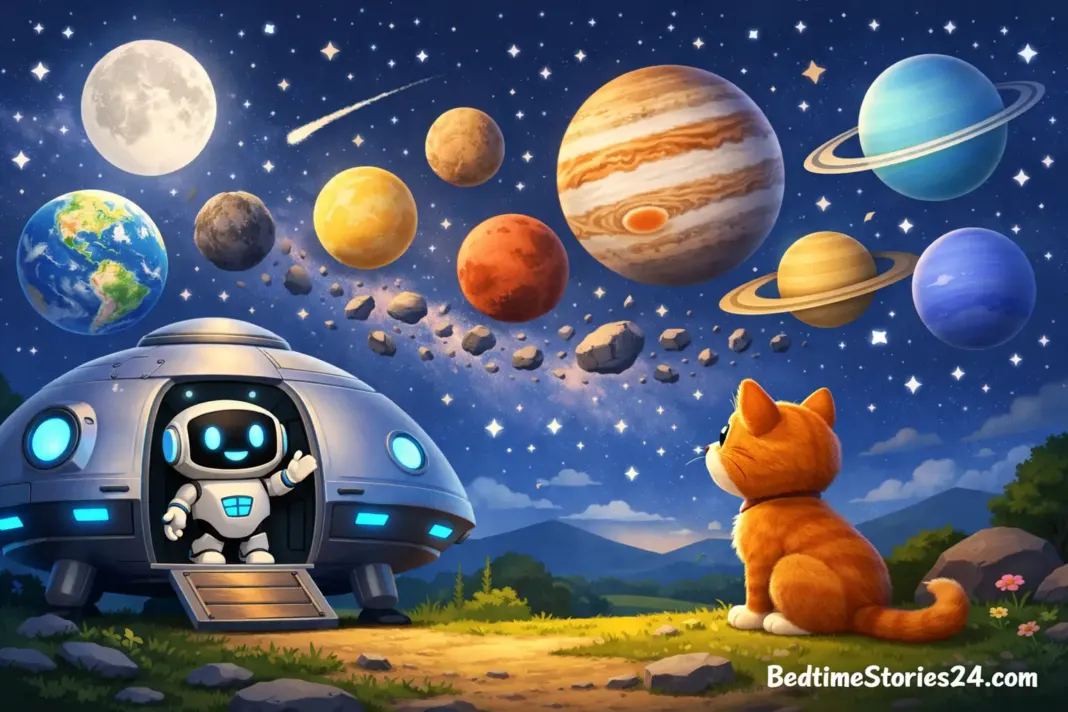

Once upon a time, in a cozy little house at the edge of a quiet town, there lived a curious orange cat named Whiskers. Whiskers was not an ordinary cat. While other cats chased butterflies and napped in sunny windows, Whiskers loved to stare at the night sky. Every evening, he would jump onto the windowsill, curl his tail around his paws, and gaze at the sparkling stars.
“I wonder what’s out there,” he would purr softly.
One special night, as the Moon shone brighter than ever, something extraordinary happened. A tiny silver spaceship, no bigger than a car, landed gently in the garden. Its door opened with a soft hiss. Inside was a friendly robot with blinking blue eyes.
“Greetings, Whiskers,” said the robot in a cheerful voice. “I am Astro. We are looking for a brave explorer to help us learn more about the Solar System. Would you like to come?”
Whiskers’ whiskers twitched with excitement. Without hesitation, he leaped into the spaceship.
With a whoosh and a shimmer of light, they blasted off into space. Earth grew smaller and smaller beneath them, looking like a beautiful blue marble.
“Why is Earth so blue?” Whiskers asked.
Astro smiled. “Earth looks blue because about seventy percent of it is covered in water. It is the only planet we know that has liquid water and life. That makes it very special.”
Whiskers purred proudly. “I’m glad I’m from Earth.”
Their first stop was Mercury. As they approached, Whiskers noticed the planet looked gray and rocky.
“Mercury is the closest planet to the Sun,” Astro explained. “It is very hot during the day and very cold at night. There is almost no air to trap heat.”
Whiskers pressed his paw against the window. “So no one could live there?”
“That’s right,” said Astro. “It’s too extreme for life as we know it.”
Next, they visited Venus. It glowed brightly, covered in thick, swirling clouds.
“Venus is sometimes called Earth’s twin because it is about the same size,” Astro said. “But it is covered in thick clouds of gas that trap heat. It is even hotter than Mercury.”
“Hotter than the closest planet to the Sun?” Whiskers gasped.
“Yes. That’s because of something called the greenhouse effect. The gases keep the heat from escaping.”
Whiskers flicked his tail thoughtfully. “Too hot for my fur.”
Soon they returned near Earth’s orbit and drifted toward the red planet, Mars. It looked dusty and quiet.
“Mars is known as the Red Planet because of the iron in its soil,” Astro explained. “Scientists think there may once have been water there long ago.”
“Water?” Whiskers’ eyes widened. “Could there have been life?”
“We are still searching for clues,” Astro replied. “That’s why Mars is very important to scientists.”
As they traveled farther, they reached the giant Jupiter. Whiskers’ jaw dropped. It was enormous, striped with brown, white, and orange clouds.
“Jupiter is the largest planet in our Solar System,” said Astro. “It is a gas giant, made mostly of hydrogen and helium. It doesn’t have a solid surface like Earth.”
Whiskers spotted a huge swirling storm. “What’s that spot?”
“That is the Great Red Spot, a giant storm that has been raging for hundreds of years.”
Whiskers shivered. “I wouldn’t want to chase a ball there.”
Next came Saturn, with its magnificent rings sparkling like cosmic jewelry.
“Ohhh!” Whiskers breathed. “It’s beautiful!”
“Saturn’s rings are made of ice and rock,” Astro explained. “It is also a gas giant, like Jupiter.”
Whiskers imagined batting at the icy rings like toys but decided it was best not to.
They continued to Uranus, which glowed a soft blue-green.
“Uranus rotates on its side,” Astro said. “It looks like it’s rolling around the Sun. That makes its seasons very unusual.”
“Rolling like a playful kitten!” Whiskers laughed.
Finally, they reached Neptune, deep blue and windy.
“Neptune is very far from the Sun,” Astro explained. “It has the strongest winds in the Solar System.”
Whiskers noticed how dark space had become. “It’s very cold here.”
“Yes,” said Astro gently. “The farther a planet is from the Sun, the less warmth and light it receives.”
On their journey home, they passed a field of floating rocks.
“These are asteroids,” Astro said. “They are pieces of rock left over from when the Solar System formed.”
Whiskers watched them carefully. “Space is full of surprises.”
As Earth grew larger in the window, Whiskers felt grateful. He thought about Mercury’s heat, Venus’s thick clouds, Mars’s red dust, Jupiter’s storms, Saturn’s rings, Uranus’s sideways spin, and Neptune’s icy winds.
When they landed back in the garden, Astro turned to Whiskers. “You have seen all the planets. What have you learned?”
Whiskers thought carefully. “I learned that every planet is different and special in its own way. Some are hot, some are cold. Some are rocky, and some are made of gas. But Earth is the only one that has everything we need—air, water, and life.”
Astro’s eyes blinked brightly. “That is a wonderful lesson.”
Whiskers hopped out of the spaceship just as the first light of morning appeared. The spaceship lifted off and disappeared among the fading stars.
From that day on, Whiskers still sat at the window every night. But now, when he looked at the sky, he didn’t just see twinkling lights. He saw worlds—each with its own story.
And whenever children visited the house and asked why he stared at the stars, Whiskers would simply purr, knowing that the universe was vast, fascinating, and full of knowledge waiting to be discovered.
And so, the curious cat who once wondered about the sky became the wisest cat in town, reminding everyone that asking questions and exploring the unknown is the first step toward learning something amazing.