
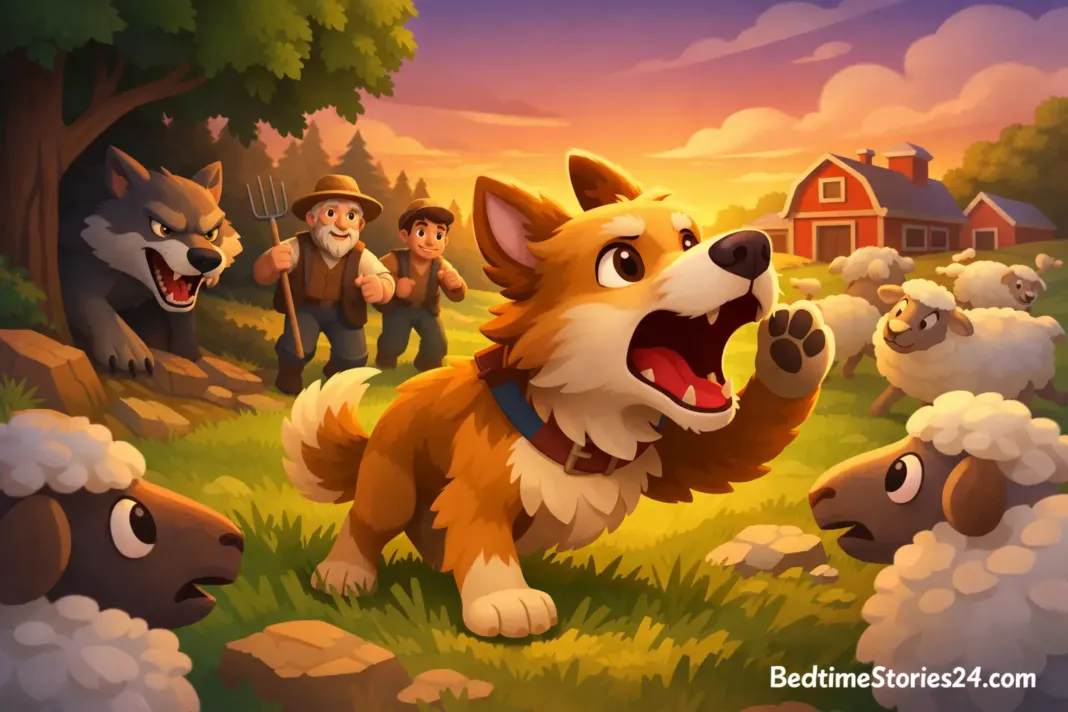
Green Valley Farm lay just beyond the quiet hills of a small countryside village. Sheep grazed peacefully on the soft grass, white clouds drifted lazily across the sky, and the days passed in gentle routine. The farm belonged to a kind shepherd named Mr. Alden, who relied on his loyal dog, Bruno, to help guard the flock.
Bruno was a strong, golden-furred sheepdog with sharp ears and a louder bark than any dog in the valley. At first, he took his job very seriously. He circled the sheep carefully, watched the tree line for movement, and slept lightly so that even the snapping of a twig would wake him.
But guarding sheep day after day can feel slow and uneventful, especially for a young dog full of energy.
One warm afternoon, as the sheep chewed lazily and cicadas buzzed in the tall grass, Bruno felt terribly bored. Nothing ever happened. No wolves. No foxes. Not even a stray rabbit worth chasing.
“I wish something exciting would happen,” Bruno muttered to himself.
He looked toward the farmhouse in the distance and noticed Mr. Alden repairing a fence. An idea—mischievous and sparkling—popped into his head.
“What if I bark as if there’s a wolf?” Bruno thought. “Everyone will come running. It will be thrilling!”
Without thinking further, Bruno leaped onto a small rock and barked with all his might.
“WOLF! WOLF! DANGER IN THE WOODS!”
His voice echoed across the valley. The sheep scattered in panic. Mr. Alden dropped his tools and ran toward the field with a long wooden stick in hand. Two farmhands followed closely behind.
“Where is it, Bruno?” Mr. Alden called, breathless.
Bruno tried to hold a serious expression, but his tail wagged uncontrollably. There was no wolf. There had never been a wolf.
The men searched the bushes, scanned the hills, and found nothing.
Slowly, they turned toward Bruno.
“There was no wolf,” Mr. Alden said, frowning. “You must not bark unless there is real danger.”
Bruno lowered his head, pretending to be ashamed. But inside, he felt a strange thrill. Everyone had come running. It had worked.
The next day was even quieter than the first. Bruno’s boredom returned like an itch he couldn’t scratch.
“Maybe just one more time,” he whispered to himself.
Again he barked wildly. “WOLF! WOLF IN THE TREES!”
The sheep panicked once more. Mr. Alden and the farmhands rushed back, more hurried and worried than before.
They searched longer this time. Still nothing.
Now Mr. Alden’s face was not just tired—it was disappointed.
“Bruno,” he said firmly, kneeling beside the dog, “when you cry wolf and there is none, you frighten the sheep and waste our strength. A guard dog must be trustworthy. Do you understand?”
Bruno avoided his eyes. He did understand—but the excitement had been so much fun.
Over the next week, Bruno barked false alarms two more times. Each time fewer people came running. The farmhands began to grumble.
“He’s imagining things,” one said.
“Or playing tricks,” said another.
The sheep themselves grew confused. At Bruno’s barking, they hesitated before scattering. Some merely glanced up and continued chewing.
Then one evening, as the sun dipped low and painted the sky orange and purple, a real shadow slipped between the trees.
Bruno saw it first—a lean gray wolf with sharp eyes and silent paws.
The wolf crept closer, its gaze fixed on the smallest lamb near the edge of the flock.
Bruno’s heart thudded. This was no game. No boredom. No trick.
He sprang forward and barked louder than ever before.
“WOLF! WOLF! PLEASE, HELP!”
The sheep looked up nervously but did not run far.
At the farmhouse, Mr. Alden paused. He listened. Bruno’s bark sounded urgent—but it had sounded urgent before.
“He’s probably playing again,” one farmhand muttered.
They stayed where they were.
Bruno barked until his throat burned. He ran toward the farmhouse, then back toward the sheep, desperate.
The wolf lunged.
Chaos erupted. Sheep scattered in every direction. Bruno threw himself at the wolf, snapping and growling. Though brave, he was young and alone.
Just as the wolf grabbed a lamb by its wool, Bruno bit hard at its leg. The wolf snarled and turned on him.
At last, hearing the true terror in the barking and the frightened bleating, Mr. Alden sensed something was wrong. He grabbed his stick and ran, the farmhands following close behind.
They arrived just in time to drive the wolf away, shouting and waving their sticks. The wolf vanished into the forest shadows.
One lamb had been injured. Bruno lay panting in the grass, his fur scratched and dusty.
Mr. Alden knelt beside him.
“There really was a wolf,” he said softly.
Bruno lowered his head, not from guilt this time—but from shame. If he had not lied before, help would have come sooner. The sheep would not have hesitated. The men would have believed him immediately.
The injured lamb recovered after many days of care. Bruno recovered too, though a thin scar remained on his shoulder—a reminder of that evening.
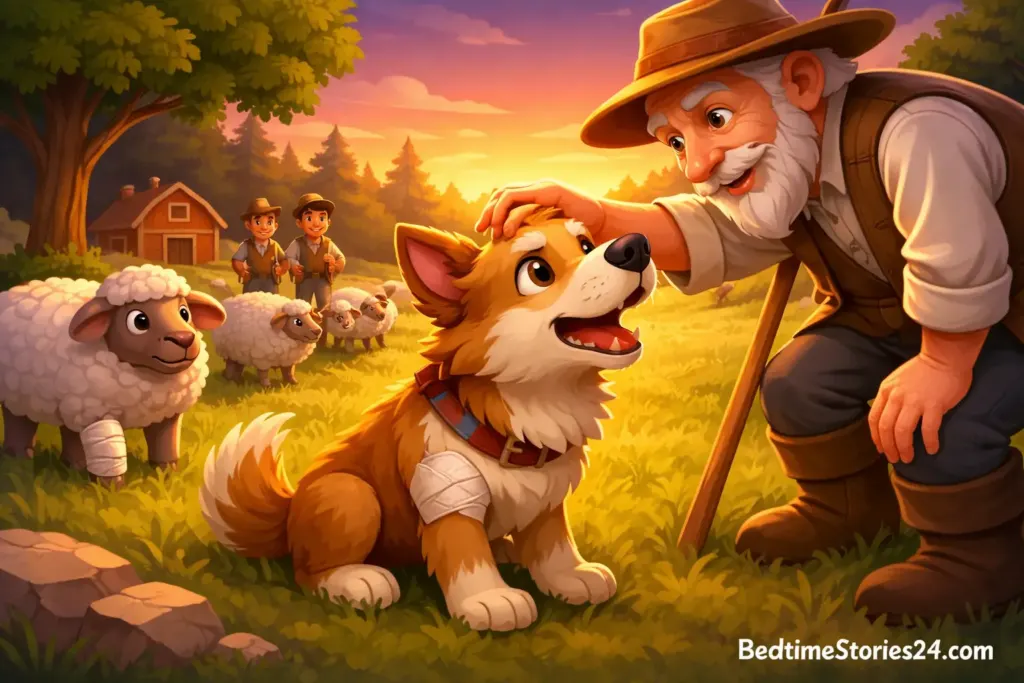

From that day forward, Bruno never barked without reason. When he did raise his voice, the entire farm listened. The sheep trusted him again. Mr. Alden trusted him too—but it had taken time, patience, and many quiet, honest days to rebuild that trust.
Bruno learned something more valuable than excitement.
He learned that a single lie can crack the strongest bond, and that trust, once broken, is much harder to mend than a fence or a wounded paw.
And in Green Valley Farm, whenever the wind rustled the trees and Bruno gave a single warning bark, everyone knew it meant exactly what it said.
Because a voice that speaks the truth is a voice worth hearing.