
Once upon a time, there lived a husband and wife who loved each other deeply. Yet despite their greatest wish, they could not have a child. The woman never lost her faith and often whispered to herself, “God will grant me a child one day.”
Behind their modest home stood a small window that looked out onto a magnificent garden. This garden was filled with the most fragrant herbs and the most beautiful flowers anyone could imagine. However, it was surrounded by high walls, and no one dared to enter, for it belonged to a powerful sorceress whom everyone feared.
One day, as the woman sat by the window, her eyes fell upon a patch of fresh, green rampion growing abundantly in the garden. It looked so crisp and inviting that her desire for it grew overwhelming. She longed for the rampion day and night, until she could think of nothing else. Knowing she could not have it made her weaker each day; she grew pale, thin, and ill.
Her husband, alarmed by her condition, asked, “What troubles you so? Why do you look as though all life has left you?”
With a sigh she replied, “If I cannot eat some of that rampion from the garden behind our house, I fear I shall die.”
Loving his wife dearly, the man resolved to do whatever was necessary to save her. That very evening, under cover of darkness, he climbed over the high wall and slipped into the forbidden garden. He quickly gathered a bundle of rampion and hurried home. The woman prepared it into a salad and ate eagerly, but her craving only grew stronger. By the next day, she begged for more.
Unable to bear her suffering, the man returned to the garden a second time. But as he climbed down the wall, he suddenly found himself face to face with the sorceress. Furious, she cried, “How dare you steal from my garden! You shall pay dearly for this!”
Trembling with fear, the man pleaded, “Please forgive me. I did this only for my wife. She is with child, and her craving is so great that without this plant she may die.”
The sorceress paused, her anger slowly cooling. “Very well,” she said. “You may take as much rampion as you wish—but on one condition. The child your wife will bear must belong to me. I will raise the child myself and care for it as my own.”
With no other choice, the man agreed. When his wife later gave birth to a baby girl, the sorceress appeared, took the child away, and named her Rapunzel.
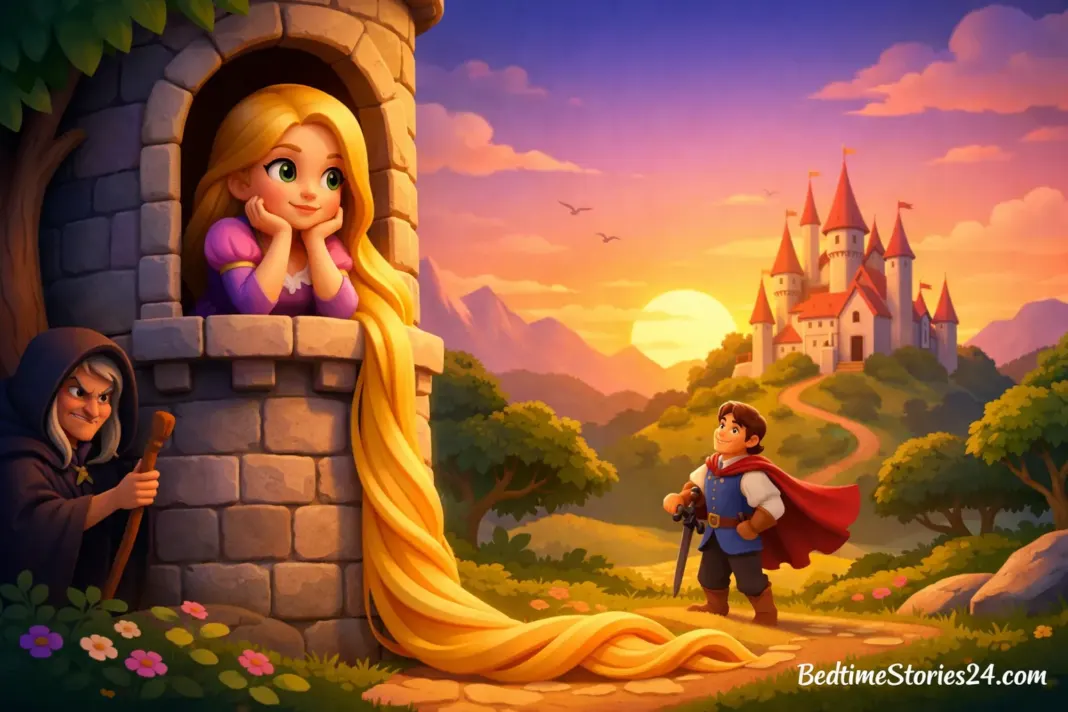
Rapunzel grew into the most beautiful child anyone had ever seen. When she turned twelve, the sorceress locked her away in a tall tower deep within the forest. The tower had no door and no staircase—only a small window at the very top.
Whenever the sorceress wished to enter, she stood below and called out:
Rapunzel, Rapunzel,
Let down your hair.
Rapunzel would then unfasten her long, golden hair, wrap it around a hook by the window, and let it fall to the ground. Using the hair as a rope, the sorceress climbed up into the tower.
Years passed in this way. One day, a young prince was riding through the forest when he heard a song so sweet and sorrowful that he stopped in wonder. It was Rapunzel, singing to ease her loneliness. The prince searched for a door to the tower but found none. Though he left, her voice remained in his heart, and he returned day after day to listen.
One evening, he saw the sorceress arrive and heard her call out the familiar words. When Rapunzel lowered her hair, the prince understood the secret.
The next night, after darkness fell, he stood beneath the tower and called:
Rapunzel, Rapunzel,
Let down your hair.
Rapunzel did so, and the prince climbed up. At first she was terrified to see a stranger, for she had never seen a man before. But the prince spoke kindly and told her how her song had touched his heart. His gentle manner soon calmed her, and when he asked her to become his wife, she agreed, believing he would care for her far better than the old sorceress.
“I would gladly go with you,” Rapunzel said, “but I do not know how to escape. Bring me a skein of silk each time you come. I will weave them into a ladder, and when it is finished, I can climb down.”
They agreed that the prince would visit only in the evenings, for the sorceress came only during the day.
For a while, their secret remained hidden. But one day, without thinking, Rapunzel asked the sorceress, “Why is it so much harder to pull you up than it is to pull up the young prince?”
At once, the sorceress knew the truth. In a rage, she seized Rapunzel’s hair, cut it off, and banished her to a barren desert, where the poor girl lived in misery.
That same evening, the sorceress tied the severed hair to the window. When the prince arrived and called out, he climbed up—only to find the sorceress waiting for him.
“Your little bird has flown,” she mocked. “You will never see her again.”
Overcome with grief, the prince leapt from the tower. He survived, but thorns pierced his eyes, and he became blind. He wandered helplessly through the forest for years, living on roots and berries, weeping for his lost love.
At last, his wandering brought him to the desert where Rapunzel lived. She had given birth to twins—a boy and a girl—and was struggling to survive. When she heard the prince’s voice, she ran to him, recognized him at once, and embraced him. Her tears fell into his eyes, and by a miracle, his sight was restored.
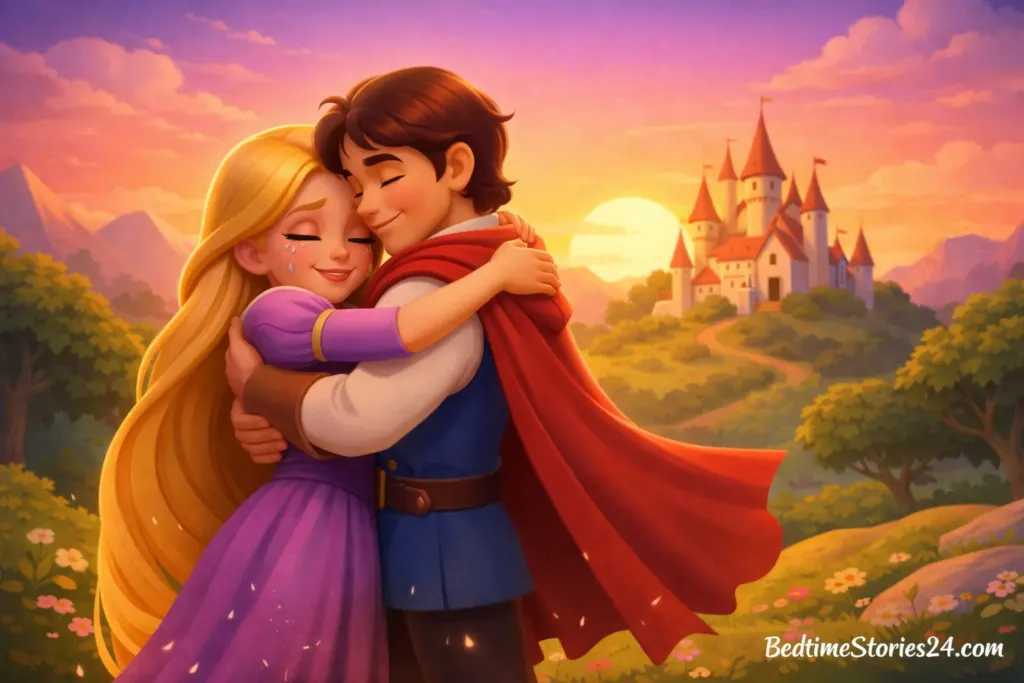

The prince took Rapunzel and their children back to his kingdom, where they were welcomed with great joy. They lived happily ever after, in love and peace, for the rest of their days.